
Based on research initiated in the 18th century by French physicist Pierre Bertholon de Saint-Lazare and others, Electroculture Gardening revisits early investigations into the use of the Earth’s electric fields and atmospheric currents in agriculture. While never fully institutionalized, these methods continue to circulate between scientific inquiry, speculation, and contemporary DIY practices.
Extending this this research toward the map where electricity becomes perceptible as matter. Introducing the notion of Plasma (physics) – an ionized state in which energy manifests as light – the installation considers plasma as a moment of transformation: when invisible electrical relations potentially or methaporically intensify into visibility.
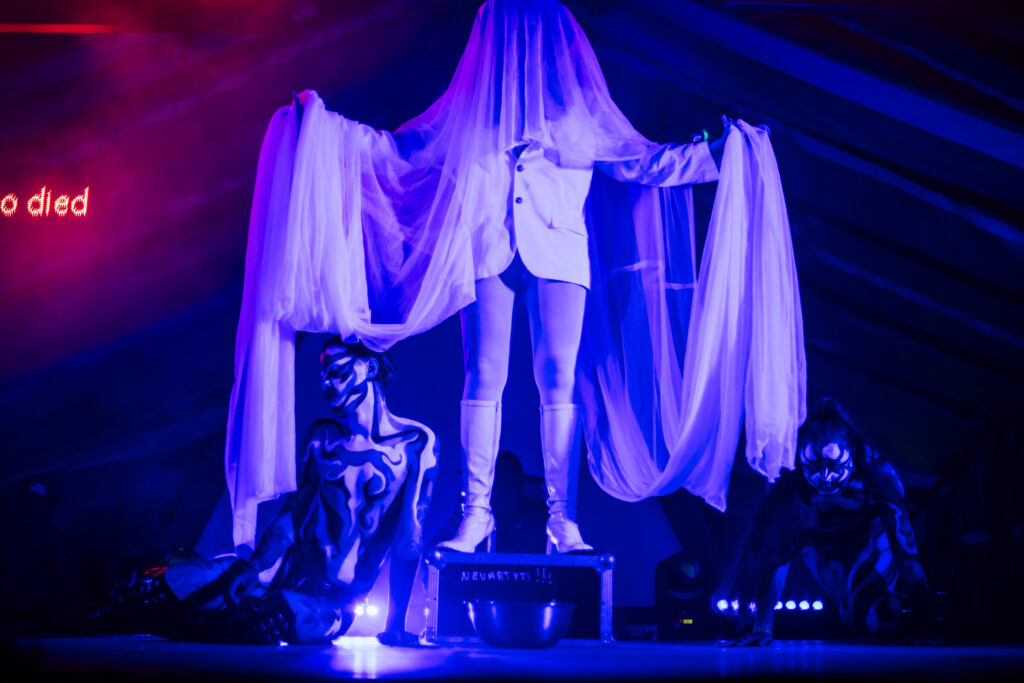
The work situates the human bodies within this expanded electrical ecology. As a site of Bioelectricity, the body both generates and responds to subtle electromagnetic fields, participating in exchanges that remain largely imperceptible. The installation interpretating these phenomena as parallel systems – botanical, atmospheric, and corporeal – each shaped by electrical forces operating across different scales and intensities.
The structures of the gates reflects geometric motifs characteristic of Lithuanian textiles. Antennas and sculptural elements function as symbolic and speculative receivers, orienting the installation within a field of temporal and spatial directions tied to place and transmission.